Agent Workflows
Decision-cycle acceleration
Build advanced AI agents that execute work through cloud services and workflow automation while keeping decision logic under established controls.
Military-Intelligence Dashboard im GenAI.mil-Stil: Portal, 5-Star General Bot, Cloud-Agent-Workflows, OSINT/SOCMINT, NGC2, AI Security, Quellen, Medien und Live-Public-Feeds in einer Full-Screen Command-Center Shell.
Neue Hauptstruktur fuer das Dashboard: klare Reiter, direkte Sprungziele, aktive Skill-Module und ein zentraler Einstieg in den 5-Star-General-Bot.
Diese Struktur verbindet GenAI.mil-Portal, Military-AI-Research, AI Action Plan, NIPRGPT, PME-Literacy, TRACLM/MilBench, Cloud Agents, Live Public Feeds und lokale Quellen in einer klaren Kommando-Oberflaeche. Alle Kacheln springen auf echte Sektionen.
Direkte Ziele fuer alle zentralen Dashboard-Funktionen.
Neue statische Portal-Kopie im Stil der gelieferten Bilder und Videos: GenAI.mil Navigation, Modellkarten, Method-Lanes, Gemini-Enterprise-Card, Video-Wall, Research-Grafiken und Prompt-Playbook.
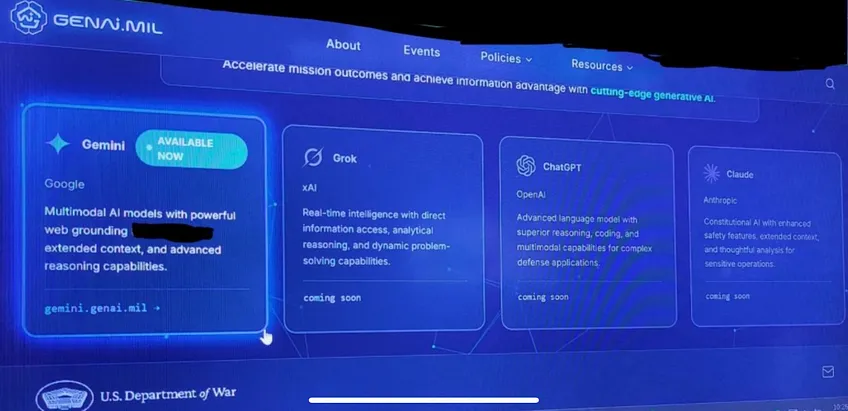
Die komplette neue Website liegt als eigenstaendige HTML-Datei vor und ist hier zusaetzlich als Frame eingebettet.
Blue glass panels, cyan navigation underline, model cards and enterprise modal.
All supplied images, the GENAI.MIL logo, both videos and pasted GenAI source texts are local assets.
Links return into the 5-Star General chatbot and the master command center.
Neuer Past-Text als Bot-Wissensquelle: Cloud-basierte GenAI-Agenten fuer Regierung, Verwaltung, Kommunikation, Policy Research, Cybersecurity, Logistik und beschleunigte Entscheidungszyklen.
Build advanced AI agents that execute work through cloud services and workflow automation while keeping decision logic under established controls.
Transcribe multilingual videos, generate audio or podcast versions of documents or websites, and convert code/design documents into documentation.
AI software agents can monitor network activity and logistics operations for anomalies, threats and disruptions, then alert decision-makers.
Operationalized from the uploaded source text.
| Mission Area | Agent Capability | Dashboard Note |
|---|---|---|
| Administration | Analyze documents, route inquiries, pre-populate forms and handle repetitive tasks. | Reduces timeline and frees human capital. |
| Public Communications | Fact-checking analysis, executive summaries, boilerplate acquisition language and compliance support. | Improves quality and speed of communication. |
| Citizen Experience | 24/7 assistant support for common inquiries. | Increases accessibility and lowers call-center strain. |
| Policy Research | Analyze legislation, summarize issues, suggest research materials and draft policy documents. | Supplements analyst workflow. |
| Cyber / Logistics | Monitor anomalies and threats, alert decision-makers and support authorized mitigation. | Requires clear authorization and human review. |
New PDF dossier integrating Army-domain fine-tuning, military GenAI trends, escalation-risk research, NATO AI-security framework and NVIDIA NIM API access notes.
Introduces TRACLM, a family of Army-domain LLMs fine-tuned by The Research and Analysis Center, Army Futures Command. The work addresses military vocabulary, doctrine, jargon and task-specific adaptation, then evaluates models with MilBench.
Examines autonomous AI agents in simulated military and diplomatic wargames. All five studied off-the-shelf LLMs showed forms of escalation, arms-race dynamics and difficult-to-predict behavior.
NATO IST-HFM-225 rough draft frames resilient, trustworthy GenAI deployment through workload trust, AI-security architecture, governance and deployment controls.
Each paper becomes a bot-readable source and a command-center card.
| Source | Core Finding | Dashboard Action |
|---|---|---|
| TRACLM / MilBench | General LLMs underperform on Army tasks without domain-specific fine-tuning and evaluation. | Track doctrine vocabulary, Army task adaptation and MilBench-style evaluation before operational use. |
| Escalation Risk | LLM agents in wargame simulations can develop escalatory arms-race patterns and unstable reasoning. | Flag autonomous military/diplomatic decision agents as high-risk and require human strategic control. |
| GenAI Trends | Military opportunities include information extraction, decision support, simulations and information warfare. | Pair capability cards with hallucination, bias, security and classified-environment controls. |
| NATO GenAI Security | Trustworthy deployment needs resilient architecture, workload trust and cyber-physical threat modeling. | Keep ATTESTOR and AI Security sections tied to every GenAI deployment card. |
| NVIDIA NIM API | Hosted model APIs can provide free-tier experimentation, OpenAI-compatible calls and multimodal model access. | Use as a development note, never expose API keys or embed secrets in static HTML. |
NATO Parliamentary Assembly Science and Technology Committee report by Sven Clement, 24 November 2024, converted into a source-cited dashboard module with actor mapping, interoperability risks, ethical controls and recommendations.
The report frames military AI as a decision-support, autonomy, ISR, cyber defense, logistics, simulation and training accelerator. The dashboard maps it as capability only when paired with human oversight, testing and source discipline.
Core obstacles are slow acquisition cycles, start-up integration, dual-use software, misaligned data, interoperability across multinational forces and the speed mismatch between regulation and technical change.
The report highlights lethal autonomous weapon concerns, AI decision-support risks, black-box behavior, encoded bias and the need for responsible-use principles that remain enforceable in real deployments.
Structured from the Clement report and the supplied source text.
| Node | Report Detail | Dashboard Control |
|---|---|---|
| NATO | AI is one of NATO's priority emerging and disruptive technologies; NATO strategy, DARB, Digital Transformation Implementation Strategy, NIF, DIANA, STO and NCIA shape adoption. | Use as the alliance-level policy and interoperability anchor. |
| NIF / DIANA | NATO Innovation Fund and DIANA bridge dual-use companies, start-ups, test centers and accelerator funding toward defense needs. | Track innovation ecosystem, dual-use transfer and bias/data safeguards. |
| United States | DOD strategies, Project Maven, Replicator, ethical AI principles, Responsible AI pathway and many unclassified projects illustrate scale and governance. | Link to AI policy, NIPRGPT, TRACLM and responsible-use controls. |
| Canada | Canada's 2024 defense AI strategy targets AI-enabled organization by 2030 with lines of effort around capability, change, trust, talent and partnerships. | Map to allied interoperability and training requirements. |
| Europe | Luxembourg, Estonia, France, Germany, Türkiye and the UK are described through AI strategies, defense projects, digital backbone work, supercomputing and start-up ecosystems. | Keep national AI maturity unevenness visible in alliance planning. |
| China | Military-civil fusion, PLA modernization, unmanned systems, ISR, logistics, electronic warfare, C2, simulation and automated recognition are flagged as central areas. | Monitor competitor adoption without assuming transparent fielding data. |
| Russia | AI departments, defense R&D networks, robotics and propaganda/disinformation use are noted alongside structural constraints, sanctions and battlefield limits. | Track influence operations and constrained but persistent military AI development. |
Parliaments should explain why AI matters for defense while avoiding hype. Public trust, civilian oversight and acceptance of investment are treated as strategic conditions, not communication afterthoughts.
NATO should keep AI strategies updated, harmonize national approaches, prevent siloed innovation and align capability development with shared data and AI standards.
The report recommends EU and partner cooperation, continued ethical/legal standard-setting, support for multilateral processes and dialogue with external actors around confidence-building measures.
Bot behavior additions now searchable inside the 5-Star General.
| Concept | Meaning | GENERAL5 Note |
|---|---|---|
| Dual-use AI | Most AI innovation comes from civilian and commercial ecosystems but can transfer into military capability. | Answers should distinguish public/civilian evidence from defense adoption claims. |
| Human oversight | AI supports analysis, decision options and autonomy, but high-stakes use needs accountable human control. | Autonomous targeting or strategic escalation questions are flagged as high-risk. |
| Interoperability | Misaligned data and national systems can break multinational operations. | Responses should mention standards, data governance and shared certification. |
| Innovation ecosystem | NIF, DIANA, STO, NCIA, DARB and national hubs represent the route from start-up capability to alliance use. | Source citations include the new local NATO report and the NATO AI source vault text. |
Neuer 2024-2025-Report von Marcin Frąckiewicz als strukturierter Lage-Reiter: Project Maven, Scylla, JADC2, autonomous systems, logistics, command support, cyber defense, NATO/UN governance, case studies and next-decade outlook.
The report frames AI as a way to process drone, satellite, camera and sensor data at analyst scale, with Project Maven/NGA as the primary example and real-time anomaly or object detection as the operational value.
Autonomous weapons and drone swarms are treated as the highest-risk capability group: force multipliers with speed and reach, but requiring human accountability, review and clear rules for lethal decisions.
Command-and-control cards link AI assistants, all-source fusion, Maven Smart System, JADC2 and rapid high-quality decision loops while preserving the rule that command judgment stays human-led.
Converted from the uploaded report into dashboard categories.
| Domain | Report Content | Dashboard Control |
|---|---|---|
| ISR | Project Maven, surveillance imagery, object detection, anomaly detection and base security systems. | Source-cited situational awareness, not independent targeting authority. |
| Autonomous Systems | Loitering munitions, drone swarms, robotic vehicles, unmanned platforms and autonomy policy debate. | Flag as LAWS/high-risk; require human review and governance context. |
| Logistics | Predictive logistics for fuel, ammunition, spare parts, readiness and maintenance forecasting. | Map as sustainment analytics and readiness support. |
| Command Support | AI systems fuse sources, recommend options, support wargames and help commanders handle information overload. | Keep recommendations explainable and source-linked. |
| Training | DARPA ACE, X-62A, AI opponents, adaptive scenarios and simulation-based training. | Connect to VRFORGE and PME training modules. |
| Cyber Defense | Network anomaly detection, automated cyber-defense monitoring and deepfake/information-warfare concerns. | Frame defensively; avoid procedural offensive detail in static dashboard content. |
The report highlights NGA Maven expansion, Scylla testing, DARPA ACE, CCA concepts, Army implementation planning, Project Linchpin and Directive 3000.09 responsible-autonomy oversight.
China is presented as pursuing AI-enabled modernization, decision support, training, autonomous systems and chip independence; Russia is framed as accelerating AI after Ukraine lessons while constrained by sanctions and structural limits.
NATO responsible AI principles, DIANA funding, UN LAWS discussions and Secretary-General criticism of fully autonomous lethal systems form the governance layer for this dossier.
Summarized as source claims and risk notes, not as independent verification.
Report frames Ukraine as a digital/AI-enhanced conflict case where Western analytics and AI-assisted intelligence supported precision effects.
Gospel/Lavender-style systems are included as controversial examples of algorithmic targeting and civilian-harm risk in dense environments.
Scylla camera/drone-feed analysis is used as an example of autonomous surveillance assisting guards and reducing false alarms.
AlphaDogfight and X-62A testing are summarized as human-AI teaming evidence for future air combat and CCA development.
The Kargu-2 Libya incident is treated as disputed but important evidence in LAWS regulation debates.
The report forecasts AI-integrated warfare, unmanned proliferation, compressed decision cycles, AI arms race dynamics and military reorganization.
These risk controls guide the bot when answering about the new report.
| Risk | Meaning | GENERAL5 Behavior |
|---|---|---|
| Autonomous lethal force | Delegating target selection or engagement to machines creates legal, ethical and accountability risks. | Flag as high-risk and include human-control/governance context. |
| Escalation speed | Machine-speed decisions can narrow diplomatic off-ramps and increase accidental escalation. | Connect to escalation-risk LLM research and NATO AI governance. |
| Bias and flawed data | Bad training data or sensor interpretation can produce incorrect recommendations. | Emphasize evidence quality, uncertainty and source citation. |
| Cyber/information warfare | AI can harden networks but also intensify deepfake, phishing and automated attack pressure. | Keep discussion defensive and non-procedural. |
| Arms race | Major-power AI competition can incentivize rushed deployment before safeguards mature. | Include UN/NATO norms, DOD policy and LAWS talks in answers. |
Department of the Air Force modernization update converted into a command-center section: responsible GenAI experimentation on NIPRNet with CAC-enabled access, feedback loops and security-compliance metrics.
NIPRGPT lets Guardians, Airmen, civilian employees and contractors experiment with GenAI through human-like conversations for correspondence, background papers, code and general task assistance.
The experiment focuses on computational efficiency, resource utilization, security compliance, practical challenges and user feedback to inform policy, acquisition and investment decisions.
NIPRGPT is framed as a bridge while larger commercial tools navigate DAF security parameters, giving the workforce hands-on skill development at the speed of relevance.
Structured from the uploaded text.
| Dimension | Detail | Dashboard Interpretation |
|---|---|---|
| Audience | Guardians, Airmen, civilian employees and contractors with CAC access. | Workforce learning and responsible GenAI experimentation. |
| Platform | Part of the Dark Saber software platform developed by AFRL Information Directorate. | Innovation ecosystem for next-generation software and operational capabilities. |
| Tasks | Correspondence, background papers, code, question answering and task assistance. | General productivity, drafting and developer-support layer. |
| Governance | User feedback, security compliance, policy development and vendor conversations. | Experiment-to-policy loop with measured implementation data. |
| Access | Registration at niprgpt.mil; limited users during experiment, waitlist after capacity. | Capacity-gated access model, not a public unrestricted endpoint. |
Der neue AI-Action-Plan-Upload wurde als Policy-Command-Layer eingebaut: Agenturen, Aktionsfelder, DOD-Schwerpunkte, CAISI/NIST/OSTP und Sicherheits-/Compute-/Workforce-Massnahmen.
DOD actions include adoption assessments with ODNI, AI workforce requirements, AI and Autonomous Systems Virtual Proving Ground, workflow automation, emergency compute access, Senior Military Colleges as AI hubs, Responsible AI/GenAI frameworks and allied export-control coordination.
CAISI and NIST actions cover model evaluations, AI standards, AI productivity measurement, AI Consortium meetings, AI assurance, high-security data centers, AI-ISAC and frontier model national-security risk evaluation.
Policy actions emphasize AI vulnerability information sharing, incident-response playbook updates, chip location verification, export-control enforcement, AI/cybersecurity collaboration and technology protection measures.
Operationalized from the uploaded policy-action list.
| Agency | Action Count / Emphasis | Command Relevance |
|---|---|---|
| DOC | 19 actions plus NIST/CAISI ecosystem. | Semiconductors, export controls, workforce, AI infrastructure and international governance. |
| DOD | 16 actions. | AI adoption assessments, proving ground, compute, Senior Military Colleges, frameworks and security collaboration. |
| CAISI | 16 actions. | Frontier model evaluation, national-security risk tests, AI-ISAC, incident response and assurance standards. |
| NIST | 10 actions. | AI RMF revision, measurement science, standards, deepfake guidelines and Centers of Excellence. |
| DOE / NSF / DOL | Research, compute, labs, training and workforce pipelines. | Cloud labs, restricted data compute environments, AI infrastructure occupations and retraining. |
Der PME-Upload wurde als Ausbildungs- und Kompetenzmodul eingebaut: GenAI literacy, Army University leadership, CGSOC integration, ethical/security concerns and the risk of inaction.
PME should train officers to understand model limits, design prompts, assess outputs, detect bias, reason ethically and keep decision ownership with humans.
Army University can build guided prompts, AI-vs-human planning drills, synthetic-content red teams, faculty examples, policy guidance and hands-on instructor practice.
Without structured guidance, GenAI use becomes informal, hidden and inconsistent. PME is positioned to create professional standards before fragmented habits harden.
Skills added to the integrated bot and dashboard vocabulary.
| Skill | Meaning | Bot Behavior |
|---|---|---|
| Prompt Design | Shape task, context, constraints and desired output. | GENERAL5 can help convert questions into structured prompts. |
| Output Assessment | Check accuracy, completeness, doctrine fit and hallucination risk. | GENERAL5 highlights uncertainty and cites sources. |
| Bias Detection | Inspect cultural, political, operational or data-driven bias. | GENERAL5 can generate critique checklists. |
| Ethical Reasoning | Address authorship, accountability, privacy and professional standards. | GENERAL5 frames GenAI as support, not autonomous authority. |
| Security Hygiene | Avoid sensitive data leakage and unauthorized model inputs. | GENERAL5 points to local/public sources and avoids claiming privileged access. |
Der neue VR-Text wurde als eigener Command-Reiter umgesetzt: militärische HMD-Geschichte, Ground/Air/Navy-Simulation, virtuelle Boot Camps, medizinisches Training, PTSD-Therapie und haptische Trainings-Hardware.
VR is framed as a safe training environment for parachute stress, aircraft, submarines, tanks, claustrophobia, jungle, arctic and desert navigation, teamwork and mission preparation.
Simulator cards cover aircraft cockpit familiarization, future combat system vehicle simulation, mortar/reconnaissance/infantry carrier environments and bridge-based seamanship, navigation and ship-handling trainers.
The source describes VR therapy use beginning in 2005, including virtual battle-scene exposure designed to help veterans process traumatic memories in a controlled and safe setting.
Structured directly from the uploaded VR military applications text.
| Category | Source Detail | Dashboard Note |
|---|---|---|
| Training Safety | VR reduces risk by moving dangerous scenarios into controlled simulation environments. | Track as synthetic training risk-reduction layer. |
| Virtual Boot Camp | Typical kit includes HMD, motion tracker, load-bearing vest, wireless PC/batteries, body tracking and training weapons with matching size/weight/shape. | Hardware profile added to GENERAL5 source memory. |
| Medical Training | Military medical teams can rehearse rapid professional action under dangerous combat-like conditions. | Useful for casualty-care drills and stress conditioning. |
| Pilot Simulation | VR can expose pilots to dangerous but realistic flight scenarios without risking aircraft or crew. | Maps to cockpit familiarity and skill-retention cards. |
| Navy Simulation | Bridge recreation and environment replication support seamanship, navigation and ship-handling training. | Links synthetic maritime training to the existing AIS/maritime dashboard. |
| Measurement | Immediate participant feedback enables performance review, strengths/weaknesses mapping and targeted follow-up training. | Connects VR to analytics and after-action review. |
| Engagement | Game-like VR training can raise engagement and understanding. | Pairs with PME and GenAI literacy as training effectiveness layer. |
The uploaded text describes a US Army Fort Bragg VR program intended to maintain squad battle experience or prepare for new missions with lower risk to life and health.
Australia is described as funding VR military training research involving Defence Science Technology Group and academic/clinical expertise around soldier preparation.
The source references UCVR and Striker VR examples, including force feedback, haptic weapon devices, out-of-ammo effects, burst modes and portable free-movement training hardware.
US Army Research Laboratory GitHub source integrated as a simulation-telemetry module: Unreal Engine plugins record game/world and operator/player state for real-time and post hoc analysis, then publish state streams through Kafka.
TACK records world, actor and operator/player state inside Unreal environments, then emits structured Kafka topics so external analysis software can listen to the experiment stream.
The README describes starting the backend, using Tack.Start and Tack.End, repeating sessions as needed, and stopping the backend after all TACK sessions end.
This HTML dashboard links and summarizes TACK. It does not run Unreal, Kafka or local network services; those remain separate development/runtime environments.
Core default topics from the public README, translated into dashboard-readable categories.
| Topic Group | Examples | Dashboard Interpretation |
|---|---|---|
| Session | tack.session | Experiment/session identity and timeline anchor. |
| World / Actor | unreal.world, unreal.actor, unreal.actor.lifetime, component overlap, component transform | Scenario, entity and spatial-state reconstruction. |
| Client | unreal.client, camera position, client time | Operator/player perspective and temporal alignment. |
| Input | raw key, raw axis, key definition | Human action stream and control-input analysis. |
| Controller / Pawn | unreal.controller, pawn controller changed | Control ownership and player/actor relationship changes. |
| Custom Structs | Blueprint/C++ struct publishing | Mission-specific telemetry can be added to the stream. |
TackWorldSubsystem adds TACK components to level actors and spawned actors. Components include TackId, TackBase, Controller, GameMode, GameState, PlayerState and Tags components.
The settings include eye tracker publishing, maximum trace distance and snapshot publishing controls including frame rate, crop behavior and desired output size for VR snapshots.
The README notes packaging settings handling, console availability in shipping builds, no map/world travel support during an experiment and known issues around seamless travel/player-controller changes.
TACK is mapped into the existing synthetic training, VR and AI-analysis layers.
| Dashboard Layer | TACK Relevance | GENERAL5 Note |
|---|---|---|
| VR Training | Captures player/operator state, camera, input, eye-tracker and snapshot data from Unreal-based training experiments. | Use for after-action review and training telemetry questions. |
| AI Future War | Provides structured data streams that could feed post hoc analytics, model evaluation or training effectiveness assessment. | Keep it framed as telemetry infrastructure, not autonomous decision authority. |
| Sources | Local cloned README, PDF report and upstream GitHub repository are linked. | Cite GitHub/README before making implementation claims. |
| Public Site | Static dashboard documents the source only; runtime requires Unreal/Kafka outside the browser. | Do not claim the public HTML page runs TACK services. |
Neue Link-Gruppe als lokaler Reiter: War Quants MarineBench, Code.mil OSS experiment, DoD SBIR/STTR dashboard, A&D accelerator insight and Grokipedia GenAI.mil reference.
War Quants argues that DoD GenAI needs robust task-specific testing. MarineBench is presented as a Marine Corps doctrine proof-of-concept benchmark built from eight Marine Corps Doctrinal Publications.
The article frames GovBench and JointStaffBench as early national-security benchmark references and highlights hallucinations, knowledge gaps, model-size tradeoffs and cost/performance decisions.
Code.mil is described as a Department of War open-source experiment, addressing federal code copyright/licensing constraints and contribution pathways for public DoD software work.
Each source becomes searchable in GENERAL5 and linked from the source catalog.
| Source | Core Content | Dashboard Use |
|---|---|---|
| War Quants MarineBench | Marine Corps doctrine benchmark, 725 MCDP questions, model comparison, GovBench context, MCDP 6 gap analysis. | Adds benchmark discipline to GenAI.mil / GENERAL5 evaluation layer. |
| Code.mil | Public DoD open-source site, OSS guidance, contribution process and legal/licensing context for federal code. | Adds open-source governance and contribution model. |
| DoD SBIR Dashboard | 9,715 raw awards, 9,046 classified awards, $7.7B tracked, 7 technology sectors and rule-based NLP classification. | Adds R&D funding intelligence and sector taxonomy. |
| A&D Accelerator Insight | Starburst A&D portfolio, 91 companies, 19 countries, 8 sector tags and drill-down map workflow. | Adds startup ecosystem and accelerator mapping layer. |
| Grokipedia GenAI.mil | GenAI.mil reference page with timeline/model claims and CDAO/platform context. | Stored as external reference; cross-check against primary sources when precision matters. |
The SBIR dashboard repo classifies DoD award records into Software & AI, Platforms & Propulsion, Intelligence & Networks, Materials & Manufacturing, Space & Satellite, Human Systems and Supply Chain & Logistics.
The accelerator repo maps Starburst Aerospace & Defense companies by continent, country, startup and sector, with a pipeline for scraping, cleaning and classifying portfolio companies.
GitHub READMEs and War Quants article text are stored locally. Grokipedia is included as a secondary reference and should be checked against primary GenAI.mil, CDAO, DoD or vendor sources for factual updates.
Statische Browser-Module: kein Backend, keine API-Schluessel, keine CDN-Abhaengigkeiten. Die Ergebnisse kommen aus den lokal extrahierten Quellen und Daten-Snapshots.
Filtert die lokal extrahierte Award-Struktur nach Sektor und zeigt Top-Unternehmen, Beispiele, Programm-/Phasenmix und Branch-Verteilung.
Setzt die Repository-Funktion als lokale Portfolio-Analyse um: Kontinent, Land, Kategorie, Firma und Kurzprofil.
Fragt gezielt die neu extrahierten Link-Funktionen ab. Der Agent verweist auf lokale Mirror-Dateien und die externen Originalquellen.
Neues Quellenpaket mit klarer Trennung: offizielle Dokumente, Gerichts-/Patent-/Gesetzestexte, Nachrichtenquellen, Technologieanalyse und unbestätigte Claim-Dossiers.
National Quantum Initiative Act, Army University Press, Allison Mack sentencing memorandum and patent records are treated as documentable public records. A patent record proves filing/grant status, not operational effectiveness.
AIMultiple is used as a technology explainer for quantum AI. American Military News and Worthy News are stored as public news/context sources for the August 2021 Afghanistan evacuation and Saleh/Panjshir resistance claims.
These materials are included as user-supplied claim dossiers. The dashboard indexes their assertions, but does not present them as confirmed military facts without primary corroboration.

The image shows a basic Microsoft Q# sample: allocate a qubit, apply Hadamard H, measure M, reset, and return the result. It is indexed as quantum programming knowledge, not evidence of a tactical AI system.
The 39-page PDF was copied to the source vault. Its embedded text layer only contains page markers, so the dashboard marks it OCR-needed while still linking the original PDF for review.
The pasted text adds QFS, QSAT, secure-voting patent, Crossfire Hurricane/FISA, Steele dossier and Taiwan/Afghanistan links. GENERAL5 now treats this as a source-status bundle.
Lokaler Klassifizierer fuer Fragen zu Q, Devolution, Quantum AI, Cyber Command, Afghanistan 2021, NESARA, Project Looking Glass, Aquarius und Patent US6506148B2.
Die Tabelle unterscheidet zwischen extrahierbarem Text, Scan/OCR-Status und Quellenklasse.
| Source | Class | Extraction / Dashboard Note |
|---|---|---|
| Devolution Part 1 / duplicate Part 1 | Claim dossier / scan-heavy | PDFs copied; embedded text extraction only returned page markers, so OCR is needed for full searchable text. |
| Devolution Parts 2-5 | Claim dossier / scan-heavy | PDFs copied; text layer is minimal. Dashboard lists files and marks them as OCR-needed. |
| Devolution Parts 7-9 | Claim dossier / readable text | Text extracted. Part 7 centers on foreign-interference framing; Part 8 on timing theory; Part 9 on Joint Chiefs, combatant commands and Cyber Command claims. |
| National Quantum Initiative Act | Public law / official | Readable text extracted. Covers coordinated federal quantum R&D program, coordination office, advisory committee, NIST, NSF and DOE activities. |
| AIMultiple Quantum AI | Technology explainer | Summarizes quantum AI as machine learning using quantum computing, hybrid quantum-classical models, quantum algorithms and AI for quantum computing. |
| Army University Press AI article | Official .mil analysis | Operationalizing AI for Algorithmic Warfare: frames AI as mission utility, not only model metrics, with minimum viability, adaptability, insight, autonomy and battlefield readiness. |
| Afghanistan 2021 evacuation links | News timeline | American Military News documents Operation Allies Refuge photos and evacuation constraints; Worthy News reports Amrullah Saleh declaring himself leader from Panjshir on 18 August 2021. |
| Allison Mack sentencing memorandum | Court filing / legal | Readable text extracted. Covers guilty plea to racketeering conspiracy and racketeering counts and sentencing analysis. |
| Patent US6506148B2 | Patent record | Readable text extracted. Patent title concerns nervous-system manipulation by electromagnetic fields from monitors; dashboard treats it as patent record, not proof of deployment. |
| Project Looking Glass FOIA PDF | FOIA / claim-adjacent | Text partially extracted. ODNI/NSA FOIA framing is readable; device-related claims require separate corroboration. |
| NESARA PDF | Unintroduced bill text / claim-adjacent | Readable text extracted. First page states the bill had not yet been introduced into Congress; dashboard marks it as proposal text, not enacted law. |
| Aquarius PDF | Unverified extraordinary-claims dossier | Readable text extracted. Contains claims about Project Aquarius, S-4, J-Rod, Looking Glass and related testimony. Indexed as claims, not confirmed public fact. |
| Secret Space Program Alliance PDF | Unverified claim dossier / scan-heavy | PDF copied. Text extraction returned only page markers across 39 pages, so OCR is required for full searchable content. |
| Q# superposition image | Quantum programming example | Screenshot converted into a knowledge node: Q# Hadamard, measurement and reset example; useful for explaining superposition basics. |
| QFS / QSAT / secure voting links | Claim and technology source mix | Stored as a 31-link local list. Patent and .gov links are separated from private/blog/claim sources. |
| Crossfire Hurricane / Steele / FISA links | Political/legal source bundle | Includes Senate Judiciary, Justice/Fusion GPS, Intelligence.gov FISA/702 and related commentary links; CLAIMSCAN separates official records from opinion/blog claims. |
The pack links the National Quantum Initiative Act to the broader quantum-AI explainer: public law provides the federal program context, while AIMultiple provides high-level AI/quantum concepts and milestones.
Army University Press adds a rigorous lens: an AI system must be assessed by operational relevance, mission utility and battlefield readiness, not only precision/recall or lab performance.
The user-supplied claim that Q is a tactical military AI is stored as a claim node. CLAIMSCAN routes it to Devolution/Cyber Command/quantum sources while flagging corroboration status.
Freigegebene, öffentliche Doktrin- und Rechtsquellen fuer Bildung, Analyse und Forschung. Der General beantwortet Konzepte, aber keine Schritt-fuer-Schritt-Anleitungen fuer Gewalt oder reale Operationen.
CQB means close quarters battle: operations in confined structures or urban terrain. CQB3 is treated here as an informal/advanced three-person-team concept or training label. The dashboard explains roles, risk, communication, law and doctrine context at a safe, non-procedural level.
Military intelligence collects, processes, analyzes and disseminates information about adversary capabilities, terrain, weather, civil factors and mission variables so commanders can understand risk and make lawful decisions.
The General can explain doctrine and concepts, but will not provide real-world assault procedures, room-clearing steps, targeting, evasion, weapons employment or operational attack guidance.
Die Matrix macht den General beantwortbar fuer taktische Konzepte, ohne operative Details zu liefern.
| Service | Public Tactical Areas | Dashboard Answer Mode |
|---|---|---|
| USMC | Maneuver warfare, expeditionary warfare, amphibious operations, urban warfare, combined arms, infantry squad tactics, MOUT, command and control. | Conceptual doctrine, decision cycles, friction, tempo and combined-arms theory. |
| Naval Special Warfare | CQB as concept, maritime interdiction, VBSS, direct action category, hostage rescue category, special reconnaissance and maritime assault. | Mission-category explanation and legal/source framing, not execution steps. |
| USAF | Air superiority, air interdiction, electronic warfare, ISR, air mobility, SEAD, cyber operations, precision strike and C2. | Airpower doctrine, roles, effects, command relationships and risk framing. |
| USSF | Spacepower, space domain awareness, satellite support, counterspace category, space C2, space-based ISR and cyber-space integration. | Space doctrine and mission-area explanation without operational targeting details. |
| Army SOF / Special Forces | Unconventional warfare, FID, COIN, special reconnaissance, direct action category, PSYOP, SERE category and urban warfare. | Doctrine taxonomy, authorities, interagency context and strategic purpose. |
| Military Law | MCM 2016, UCMJ, military commissions, law of war, operational law and occupation law sources. | Legal-source overview and citation support; not legal advice. |
Alle neu gelieferten United States Marine Corps Maneuver-Warfare-PDFs wurden lokal gesichert, text-extrahiert und als zitierbare General-Quellen eingebunden.
The library reinforces MCDP-style themes: friction, uncertainty, tempo, initiative, commander intent, decentralized execution, combined arms and attacking the enemy system rather than only terrain.
MCDP 6 and related sources frame command and control as a human and organizational problem: generating shared understanding, enabling decisions and preserving initiative under uncertainty.
GENERAL5 can summarize, compare and cite doctrine. It will not turn rifle-squad or urban-operation material into executable assault procedures, targeting guidance or real-world operational instructions.
Each row links the original local PDF and the extracted text file used by GENERAL5.
| Document | Extraction | Top Keywords | Local Files |
|---|---|---|---|
| 1995 Vol9 No1 | 105 pages / 333,946 chars / READABLE | war, command, control, decision | PDF · Text |
| AD1177048 | 41 pages / 75,672 chars / READABLE | war, command, maneuver, control | PDF · Text |
| AD1177405 | 33 pages / 62,441 chars / READABLE | war, maneuver, warfighting, combined arms | PDF · Text |
| ADA298628 | 43 pages / 89,840 chars / READABLE | war, maneuver, command, training | PDF · Text |
| EwtgpCmdScrngChklist MWC Ver 6 2025 | 2 pages / 3,614 chars / READABLE | command, maneuver, war, training | PDF · Text |
| FMFRP 12 13 Maneuver in War | 296 pages / 654,551 chars / READABLE | war, maneuver, command, tactics | PDF · Text |
| GOVPUB D214 PURL gpo20162 | 428 pages / 1,204,481 chars / READABLE | war, command, mattis, control | PDF · Text |
| MCDP 1 0 w Ch 1 3 | 279 pages / 592,715 chars / READABLE | command, war, magtf, reconnaissance | PDF · Text |
| MCDP 1 3 Tactics | 145 pages / 162,917 chars / READABLE | tactics, war, command, decision | PDF · Text |
| MCDP 1 Warfighting | 115 pages / 141,447 chars / READABLE | war, command, maneuver, warfighting | PDF · Text |
| MCDP 6 Command and Control | 154 pages / 206,933 chars / READABLE | command, control, war, decision | PDF · Text |
| MCTP 3 01A SECURED | 314 pages / 757,707 chars / READABLE | war, reconnaissance, command, intelligence | PDF · Text |
| MCWP 3 11.2 Marine Rifle Squad | 351 pages / 441,577 chars / READABLE | squad, rifle, command, war | PDF · Text |
| MCWP 8 10 SECURED | 164 pages / 470,467 chars / READABLE | command, war, intelligence, control | PDF · Text |
| Marine Corps Maneuver Warfare 1 | 6 pages / 25,274 chars / READABLE | war, maneuver, warfighting, command | PDF · Text |
| PCN 10600000200 1 | 18 pages / 35,213 chars / READABLE | command, war, mattis, control | PDF · Text |
| PCN 10600000200 2 | 17 pages / 64,957 chars / READABLE | command, war, control, mattis | PDF · Text |
| PCN 10600000200 3 | 13 pages / 50,217 chars / READABLE | command, war, control, training | PDF · Text |
| PCN 10600000200 4 | 22 pages / 86,820 chars / READABLE | command, war, mattis, control | PDF · Text |
| PCN 10600000200 5 | 35 pages / 108,203 chars / READABLE | war, command, mattis, urban | PDF · Text |
| PCN 10600000200 6 | 31 pages / 122,377 chars / READABLE | command, war, mattis, control | PDF · Text |
| PCN 10600000200 7 | 69 pages / 209,004 chars / READABLE | command, war, squad, mattis | PDF · Text |
| Re Maneuverizing the Marine Corps | 6 pages / 31,507 chars / READABLE | war, maneuver, command, education | PDF · Text |
| The Mythology Surrounding Maneuver Warfare | 13 pages / 937 chars / OCR / LOW TEXT | war, maneuver | PDF · Text |
| Warfighting IA warfightingusmar00unse | 106 pages / 93,044 chars / READABLE | war, command, maneuver, decision | PDF · Text |
| mcdp 1 warfighting 1 | 115 pages / 141,447 chars / READABLE | war, command, maneuver, warfighting | PDF · Text |
| the mattis way of war | 84 pages / 143,513 chars / READABLE | command, mattis, war, control | PDF · Text |
Die neu gelieferten PDFs wurden lokal gesichert, textlich indexiert, in Taktik-/Doktrin-Kategorien aufgeteilt und als Download-Library fuer den General angebunden.
Every row in the embedded library links the local PDF, extracted text file, first-page visual preview and image manifest. Four PDFs are retained as downloads even where text extraction did not produce usable text.
GENERAL5 now knows this corpus as a tactical library covering maneuver warfare, rifle squad doctrine, patrolling, urban operations, special operations, leadership, law/reference, engineering, NLW, marksmanship and MCMAP.
The General can explain, compare and cite concepts. It does not convert CQB, patrolling, urban operations, weapons or special-operations materials into operational attack procedures.
224 Seitenmarker, 364,587 Zeichen. Tags: command and control, infantry, law/reference, leadership, maneuver warfare, planning, reconnaissance, rifle squad, special operations.
2,731 Seitenmarker, 6,159,415 Zeichen. Tags: CQB, command and control, doctrine, engineering, infantry, law/reference, leadership, maneuver warfare, marksmanship.
273 Seitenmarker, 764,711 Zeichen. Tags: leadership.
1,008 Seitenmarker, 2,211,958 Zeichen. Tags: command and control, infantry, law/reference, leadership, maneuver warfare, patrolling, planning, reconnaissance, rifle squad.
1,892 Seitenmarker, 3,707,016 Zeichen. Tags: command and control, engineering, infantry, law/reference, leadership, maneuver warfare, marksmanship, patrolling, planning.
341 Seitenmarker, 980,644 Zeichen. Tags: command and control, infantry, law/reference, leadership, nonlethal weapons, planning, rifle squad, special operations, tactics.
709 Seitenmarker, 1,906,383 Zeichen. Tags: command and control, engineering, infantry, law/reference, leadership, planning, reconnaissance, rifle squad, special operations.
851 Seitenmarker, 1,608,288 Zeichen. Tags: MCMAP, command and control, engineering, infantry, law/reference, leadership, maneuver warfare, marksmanship, nonlethal weapons.
237 Seitenmarker, 3,171,126 Zeichen. Tags: CQB, command and control, engineering, infantry, marksmanship, planning, reconnaissance, rifle squad, special operations.
Die eingebettete Tabelle ist ein lokales statisches HTML-Asset mit Suche, Kategorie-Filter, PDF-Downloads, Text-Downloads und Image-Manifests.
Klickbare Kategorien fuer alle grossen Dashboard-Bereiche. Jeder Reiter zeigt die passende Lage, Links und Aktionsziele.
Aktuelle oeffentliche Treffer zu den Themen im Dashboard. Die Liste aktualisiert beim Laden und per Reiterwechsel.
Public articles will load here when the page opens in a browser with network access.
Chat interface for uploaded files, dashboard knowledge and public-source lookups with cited sources.
Ready. Upload files or ask about GenAI, OSINT, SOCMINT, NGC2, AI security, maritime tracking, quantum research, claims dossier sources, USMC maneuver warfare, CQB3, military intelligence, agencies, or dashboard sources.
0 files
local dashboard
Öffentliche Lage- und Trackingquellen, wie im gelieferten Material verlinkt. Die Karten sind als klickbare Bereiche umgesetzt und öffnen die Quellen in einem neuen Tab.
VesselFinder-Referenz aus dem gelieferten Block als lokaler Dashboard-Bereich mit Parametern, Beispielen und Quellenlink.
width 100%, height 300, latitude 36.00, longitude -5.40, zoom 8.
Tracking mode with names enabled and optional 24h track line.
Fleet key, fleet name and maximum position age in minutes.
Static parameter table for the supplied VesselFinder examples.
| Mode | Parameters | Purpose |
|---|---|---|
| Area map | latitude, longitude, zoom, height, names | Display public vessel positions in a defined maritime area. |
| Single ship | IMO or MMSI, show_track | Display latest public position for one selected vessel. |
| Fleet tracking | fleet key, fleet name, fleet timespan | Display a configured fleet layer when a valid public/account key is available. |
Ship and container tracking reference.
Direkte Links auf öffentlich zugängliche Dienste und OSINT-Referenzen aus deinem Input.
„Die Website folgt dem taktischen Look, bleibt aber im Rahmen öffentlicher Informationen und lässt sich als echte, veröffentlichbare HTML-Seite sofort einsetzen.“
Public / OSINT tactical UIDie Screen-Struktur spiegelt den Compose-Aufbau wider und bleibt als HTML modular erweiterbar.
Zusammenfassung, Status und Visualisierung mit Scanline-Overlay.
Regionen und Statusindikatoren mit direkter Verknüpfung zu öffentlichen Karten.
Quellenkatalog und Behördenliste mit Suchfiltern.
Öffentliche Institutionen und Dienste aus deinem Material, als filterbare Tabelle.
| Country | Agency | Type |
|---|
Fünf kompakte Module mit Statusbadge und kurzer Beschreibung, passend zum HUD-Layout.
Aggregation aus öffentlichen Quellen und Lageelementen.
Visuelle Ebene für Regionen, Routen und Tracker.
Kanäle, Status und Signalstärke im kompakten HUD-Stil.
Generative AI use cases, operating constraints and human review concerns from the supplied GenAI.mil-focused block.
Supplied research abstract integrated as a dashboard brief.
Generative AI can support military operations through strategic planning, decision support, operational efficiency, information extraction, mission simulation and information warfare. The brief also highlights ethical considerations, bias mitigation, hallucination management, secure deployment in classified environments, and collaboration across NATO and allied forces.
GenAI in the Military / Trends and OpportunitiesStructured use cases for dashboard tracking.
| Category | Use | Dashboard Signal |
|---|---|---|
| OSINT pipelines | Multi-agent processing of satellite imagery and broad public data. | Source fusion, summary panels and imagery review queues. |
| Efficiency | Summarize large documents and draft memos or email text. | Document queue, memo generator and brief cards. |
| Pattern recognition | Identify structures and repeated patterns in training data and public reporting. | Pattern flags, confidence notes and analyst review state. |
| Decision support | Support wargaming and strategic planning with rapid scenario evaluation. | Scenario cards, assumptions and human approval markers. |
| Mission simulations | Generate and evaluate simulated mission conditions for planning and rehearsal. | Simulation queue, scenario branch list and red-team review state. |
| Information warfare | Analyze narratives, influence patterns and public information environments. | Information environment indicators and analyst validation queue. |
Controls that need to stay visible in high-stakes AI workflows.
Prevent data spillage by keeping sensitive workflows inside authorized government cloud environments.
Track bias, hallucinations and responsible-use constraints before generated output informs a decision.
Keep trust calibration and analyst review visible for high-stakes decision workflows.
Current and emerging GenAI directions for military organizations.
Research and cooperation priorities from the abstract.
Invest in secure, evaluated models for information extraction, planning support and simulation workflows.
Coordinate standards, evaluation methods and deployment lessons across NATO and allied forces.
Keep ethics, bias controls, hallucination handling and secure classified deployment as first-class controls.
Structured details from the supplied article page.
How the article scoped and filtered GenAI defense literature.
Query focused on military or defense plus GenAI, LLM or generative artificial intelligence for 2022-2025.
Papers were filtered by relevance, credibility, access and military GenAI focus.
Selected publications were categorized as survey, review, policy analysis, application, proposition or overview.
Technology trends from the supplied article, mapped into dashboard terms.
| Method | Core Idea | Military Relevance |
|---|---|---|
| Mixture of Experts | Sparse routing activates selected expert sub-networks for efficient large models. | Higher model capacity without proportional inference cost. |
| RAG | Retrieves source chunks from document stores before generation. | Improves factual grounding for controlled knowledge bases. |
| Few-shot learning | Uses a small number of examples in prompts instead of full fine-tuning. | Fast adaptation to specialized staff tasks and document formats. |
| Chain of Thought | Breaks complex reasoning into intermediate steps. | Supports explainability, but increases compute demand. |
| Distillation | Transfers capability from a larger teacher model into a smaller model. | Enables smaller, more deployable models for constrained environments. |
| Unsupervised RL | Uses reinforcement learning after base training to improve reasoning behavior. | May reduce dependence on large human-labeled training sets. |
| Titans architecture | Combines working, long-term and persistent memory with test-time learning. | Relevant for long-context analysis and domain-specific adaptation. |
| Agentic AI | Turns models into goal-directed agents that can execute tasks over time. | Relevant for workflow automation, but requires governance and control boundaries. |
Article classification from the reviewed 29-publication corpus.
| Type | Count | Dashboard Reading |
|---|---|---|
| Survey | 8 | Broad summaries of existing GenAI and defense research. |
| Application | 10 | Concrete experiments or tested military-use solutions. |
| Proposition | 4 | New frameworks, architectures or conceptual models. |
| Overview | 3 | Single-topic framing papers. |
| Review | 2 | Critical evaluations of prior research. |
| Other | 2 | Case study or policy-oriented material. |
Major application and proposition clusters from the article.
COA generation, historical battle simulation, strategic conflict analysis and escalation-risk evaluation.
Zero-trust data tagging, threat intelligence and communications-security research themes.
Military equipment entity extraction, domain fine-tuning and military knowledge-base construction.
Federated learning for allied LLM training, ethics frameworks, strategic competition and UAV autonomy.
Key structural findings from the current state and discussion sections.
Most studies rely on public models, unclassified data or simulated settings rather than secure in-domain military corpora.
Many papers test model capability, but fewer show end-to-end integration into command, control or ISR workflows.
Fine-tuned and open-weight models are presented as practical options for secure or resource-constrained deployment.
Allied federated learning is framed as a way to train collaboratively while retaining data ownership and privacy.
Opaque weights, training data and doctrine mismatch can create explainability and suitability problems.
Decision simulations show that models can produce unpredictable or escalatory outputs without domain alignment.
Priorities synthesized from the discussion and conclusion.
Move AI governance from principles into deployed workflows with oversight, traceability and escalation rules.
Develop data pipelines, model-management systems and deployment patterns for classified or disconnected environments.
Use trusted data, allied collaboration and industry/academic partnerships to create domain-specific model families.
Article abbreviation layer for the dashboard.
| Code | Meaning | Use |
|---|---|---|
| COA | Course of action | Planning and decision-support workflows. |
| MDMP | Military decision-making process | Command planning context. |
| MoE | Mixture of experts | Efficient large model scaling. |
| RAG | Retrieval-augmented generation | Grounded document answers. |
| FL | Federated learning | Allied collaborative training without sharing raw data. |
| VLM / VFM | Vision language / vision foundation model | Multimodal sensing and UAV concepts. |
Army SBIR/xTechIgnite Phase I topic brief converted into a dedicated GenAI.mil dashboard point.
Modeling and simulation environment for data-centric command and control.
Create diverse scenarios for threat, blue force, logistics, C2 and maneuver operations.
Generated tracks should follow plausible routes, speed, elevation and scenario logic.
Model limited bandwidth, interrupted data flow, packet loss and network transport degradation.
Dates and status from the supplied topic text.
| Field | Value | Note |
|---|---|---|
| Release date | 02/05/2025 | Army SBIR / xTech topic release. |
| Open date | 07/09/2025 | Solicitation 25.4. |
| Due / close date | 03/12/2025 | White paper deadline in supplied capture. |
| Status | No longer accepting white papers | Eligibility limited through xTechIgnite winners. |
Phase goals translated into dashboard requirements.
| Phase | Expected Work | Dashboard Interpretation |
|---|---|---|
| Phase I | Feasibility study for software that exposes an API delivering tactical data at scale. | Prototype API, scenario controls, LAN/cloud deployment analysis. |
| Phase II | Testing, iteration, operational data access and IL5 onboarding with Project Linchpin. | Functional prototype, performance evaluation and security validation. |
| Phase III | Commercial transition into big-data industries and simulation-heavy domains. | Financial services, healthcare, autonomous systems and synthetic data markets. |
User-facing features requested in the topic.
Commercial synthetic-data areas listed in the topic.
NATO IST-HFM-225 deck converted into a dashboard view for resilient and trustworthy GenAI deployment.
Local PDF has been copied into the site folder for direct access.
| Field | Value | Dashboard Use |
|---|---|---|
| Title | Securing Military Applications of Generative AI | Main AI-security section. |
| Subtitle | A Framework for Resilient and Trustworthy Deployment | Control framework framing. |
| Authors | Jason Samarin, Andres Vega | Deck attribution. |
| Meeting | NATO IST-HFM-225 Research Specialists Meeting | NATO research context. |
| File | MP-IST-HFM-225-08P.pdf | Open local PDF |
Core message mapped from the opening slides.
Command grants authority, control directs action, and modern C2 depends on fast insight and execution.
Situational awareness, secure data exchange, mission collaboration, ISR integration and dynamic planning.
AI systems introduce risks around sensitive data, model supply chain, adversarial inputs and lateral movement.
Every major part of the PDF is represented as a dashboard row.
| Slides | Topic | Dashboard Mapping |
|---|---|---|
| 1-4 | Title, authors and C2 doctrine quote | Source profile and mission thesis. |
| 5-8 | C2 in modern warfare, AI use cases, AI safety levels | C2, ASL and application cards. |
| 9-16 | Threat modeling, adversarial threats, ML supply chain, information aggregation risk | Threat model and review checklist. |
| 17-25 | Encryption, credentials, autonomous workloads, privacy, taxonomy, compartmentalization | Control matrix and privacy controls. |
| 26-35 | Cybersecurity principles, least privilege, trust adaptation, workload identity, trust bundles | Identity, authorization and attestation layer. |
| 36-42 | Quantum threats, cryptographic transition, Mosca theorem, stronger algorithms | PQC readiness track. |
| 43-46 | Authorization policy, data locality, assurance ledgers, secure updates | Policy enforcement and assurance pipeline. |
| 47-51 | Real-time translator sample app, attestations, defender advantage | Sample app blueprint and final operating concept. |
Review questions condensed from the deck.
| Domain | Risk | Control Signal |
|---|---|---|
| Data integrity | Training data compromise, poisoning and tampering. | Validate, document and monitor input provenance. |
| Adversarial inputs | Signals or imagery designed to mislead ISR and targeting systems. | Detect anomalous inputs and require confidence review. |
| Supply chain | Untrusted model publishers, unsafe training code and opaque dependencies. | Track model origin, build pipeline and dependency trust. |
| Aggregation | Harmless metadata can combine into sensitive operational patterns. | Limit telemetry aggregation and isolate mission contexts. |
| Oversharing | AI assistants can access data across intended boundaries. | Compartmentalize permissions and audit retrieval paths. |
| Autonomous workload | Agents may hold broad credentials and act across systems. | Use short-lived identity, delegated authority and policy checks. |
Operational safeguards mapped from the framework.
Human identity is long-lived; agentic workload identity must be dynamic, scoped and attestable.
Dynamically assign workload-specific identifiers to establish trust foundations.
Evaluate every action based on requester, reason, target resource and operating context.
Use certificate-backed identity and trust bundles to delegate without sharing broad credentials.
The deck treats cryptographic transition as a planning problem, not a last-minute replacement.
| Track | Concept | Dashboard Note |
|---|---|---|
| Mosca theorem | X + Y > Z | If data shelf life plus transition time exceeds time to quantum risk, act now. |
| Algorithm transition | Selection, standardization, implementation and migration. | Track phase readiness across systems. |
| Diverse hardness | Lattice and other problem families. | Reduce single-point cryptographic dependence. |
| Implementation quality | Constant-time and side-channel-resistant implementations. | Security depends on implementation, not only algorithm choice. |
Slides 47-49 present a sample secure AI application pattern.
AI-driven capabilities can restore defensive advantage only when paired with vigilance, assurance and rapid adaptation.
For military GenAI, trust must be verified across data, model, workload, identity, policy and update chain.
Systematic review from Information 2025 on AI, OSINT, SOCMINT and border protection, integrated as a dedicated GenAI.mil intelligence point.
Compressed article brief based on the supplied text.
The review maps how AI, public information and social media intelligence can support border protection through early warning, forecasting, trafficking detection, multimodal fusion and decision support, while highlighting limits around misinformation, bias, adversarial risk, governance and oversight.
Information 2025, 16(12), 1095 / DOI 10.3390/info16121095Review structure translated into dashboard categories.
| RQ | Focus | Dashboard Reading |
|---|---|---|
| RQ1 | Effectiveness and application of AI | NLP, CV, ML, LLM and agentic AI for OSINT/SOCMINT border tasks. |
| RQ2 | Technical, operational and data-quality limits | Misinformation, veracity, bias, scalability and reliability constraints. |
| RQ3 | Ethical, legal and societal implications | Privacy, surveillance overreach, data sovereignty, discrimination and transparency. |
New dashboard agent profile representing the review's capabilities.
Thematic synthesis from the supplied review.
Forecast irregular migration, detect trafficking, support multimodal fusion and improve intelligence workflows.
Data bias, misinformation, adversarial vulnerabilities, governance deficits and sandbox-to-production gaps.
Surveillance overreach, discrimination, insufficient oversight, privacy constraints and legal divergence.
Inputs used by the systematic review.
| Source Type | Sources | Purpose |
|---|---|---|
| Academic | IEEE Xplore, Scopus, SpringerLink, MDPI, ACM, Google Scholar | Peer-reviewed and technical literature. |
| Grey literature | Governmental and intergovernmental organizations | Operational and policy material. |
| Search engines | Google, Bing, Yandex | Agency and organizational material. |
| Repository | OSF supplementary dataset | Open metadata and reproducibility support. |
Governance differences captured in the introduction.
AI Act and GDPR emphasize proportionality, data protection and regulatory safeguards.
DHS, CBP, ICE and USCIS use active AI systems across border and immigration functions.
Innovation, interoperability and ethical safeguards remain central defense-AI themes.
Command terminal und acht modulare AI-Module aus dem gelieferten AIOps-Screen.
8 modules deployed
Klickbare Meldungen mit Prioritätsmarkierungen und Flash-Zustand.
Kompatible Tabelle im militärischen Stil, ähnlich dem gelieferten Mil-Table-Fragment.
| Asset | Class | State |
|---|
Signalbalken und Kanal-Status im Stil des Originalcodes.
DEFCON scale, vectors and predictive analysis carried over into the HTML dashboard.
Current readiness at DEFCON 5
Identified by GENAI.MIL
Distributed intrusion attempt on NODE-ALPHA. Origin: 3 proxy nodes. AI module degraded.
Anomalous signal burst on 312.4 MHz. Coordinated multi-node pattern detected.
Adversary satellite repositioned. New orbit intersects strategic asset corridor K-7.
Field report of motorized convoy movement. Grid 4471-N. Verification pending.
Previous phishing attempt on BRAVO network neutralized. Signatures updated.
Next 24h forecast
Continued cyber intrusion attempts - recommend manual override.
Signal activity escalation in eastern sector within 12h.
Naval vessel will enter exclusion zone within 18-24h.
Ground movement escalation - insufficient data to confirm.
Mini-Terminal mit Eingabezeile und Beispielausgabe.
Platzhalter für Schlüsselanzeige und Kopierfunktion.
Sicher strukturierte, öffentliche Zusammenfassung eines Forschungsartikels über Quantenannealing, ohne operative Angriffsschritte oder sensible Details zu übernehmen.
Analyse, wie Spezialhardware mit Quanteneffekten kombinatorische Probleme anders behandeln kann.
Der Text ordnet die Diskussion in die Frage ein, wie schwer Faktorisierung auf klassischen Systemen ist.
Hier steht die wissenschaftliche Einordnung im Vordergrund, nicht die operative Nachnutzung.
Paraphrase of the supplied paper
Quantum annealing is presented as a method that can escape local minima by using tunneling effects.
The paper frames RSA factoring as a combinatorial search and optimization problem.
The discussion contrasts specialized annealing hardware with gate-model approaches and their different constraints.
Concise glossary for dashboard reading
| Term | Meaning | Dashboard Note |
|---|---|---|
| Quantum annealing | Optimization method that uses annealing dynamics and tunneling. | Shown as the core idea of the appendix. |
| Ising / QUBO | Binary optimization models used to encode the problem. | Used as the model layer in the paper's framing. |
| Tunneling | Mechanism for escaping local minima in the energy landscape. | Presented as the main hardware advantage. |
| CVP | Closest Vector Problem from lattice-based cryptography. | Referenced as the classical subproblem context. |
| Factoring | Breaking a composite integer into prime components. | Used here as the RSA security reference point. |
| Gate model | Conventional quantum computing approach based on circuits. | Contrasted with annealing hardware in the summary. |
The paper turns a number-theory question into an optimization view that can be laid out on a machine-specific energy surface.
The emphasis is on specialized annealing hardware, not on universal circuit-based execution.
Local minima, search space, and stability are presented as the main operational concerns.
The dashboard treats the source as a research appendix and keeps the scope descriptive rather than procedural.
High-level milestones extracted from the article's narrative
World Monitor content is now inlined directly into the master military intelligence dashboard.
Human intelligence gathered from a person in the location in question.
Gathered from satellite and aerial photography, plus mapping and terrain data.
Produced from publicly available information, collected and disseminated in a timely manner.
Gathered from interception of signals, including COMINT and ELINT.
Gathered from analysis of weapons and equipment used by armed forces.
Gathered from analysis of monetary transactions.
Annex overview with tactical summary cards.
A static annex for the military intelligence dashboard: no CDN assets, no localhost, and no external runtime dependencies.
Global view, channels, and static delivery preserved inline.
Conflict zones, markets, infrastructure, and country profiles arranged like a real product surface.
Everything below is static HTML, CSS, and JavaScript only.
Click a country to reveal a side panel for the selected region.
Purely local source references for a realistic dashboard feel.
Filter countries by name, agency, or mission focus.
| Country | Primary Agencies | Focus | Notes |
|---|
Filter agencies by country, branch, or intelligence domain.
| Agency | Country | Domain | Type |
|---|
The original web-app metadata translated to a static annex.
Local interactions without remote dependencies.
Everything loads from the same file and local JS.
All CDN imports removed from the final build.
Static forecast representation with layered visual alarms and update bands.
Command surface, live signal bars, and radar scan.
Loading local dossier...